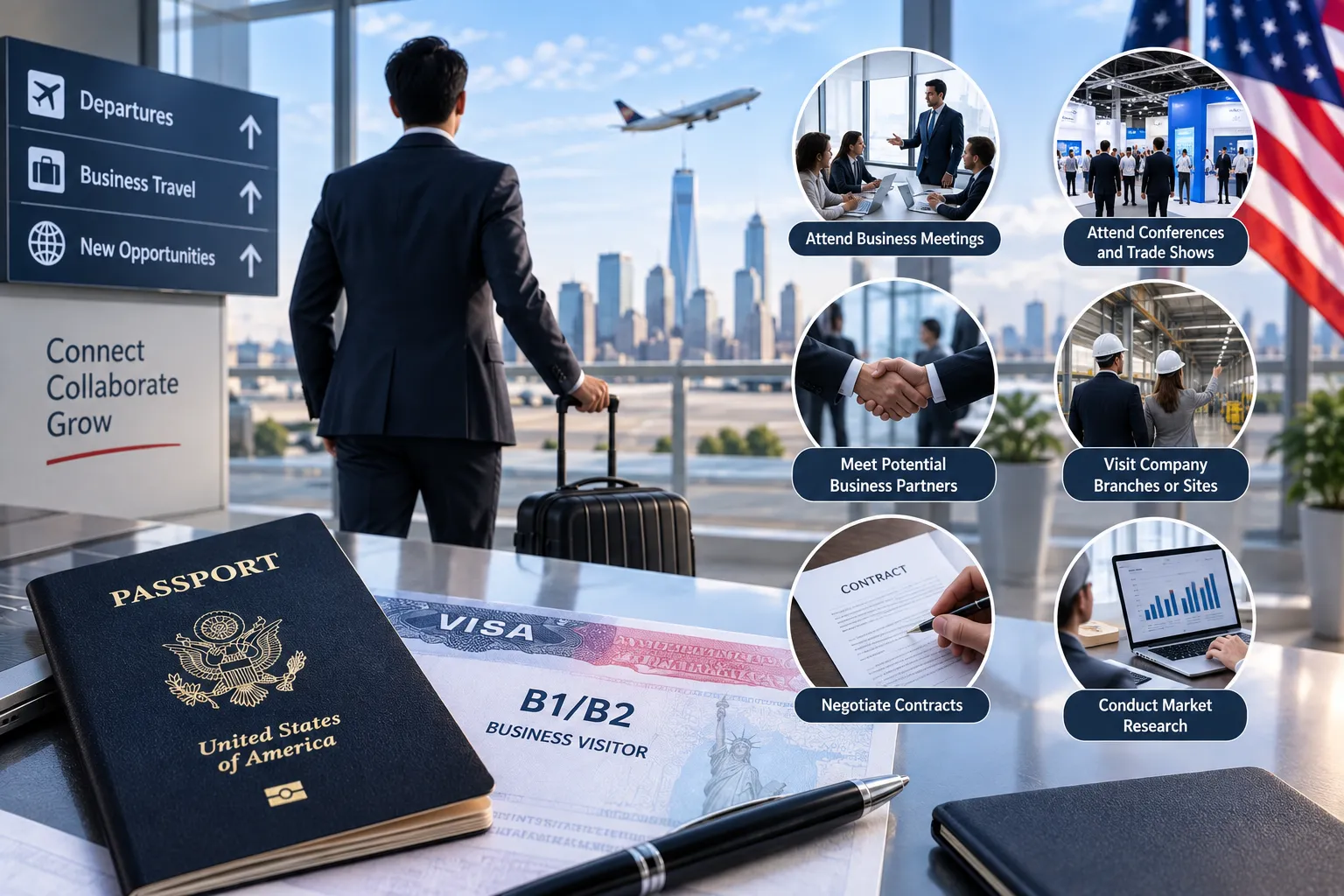
A U.S. B-1 business visa allows eligible visitors to take part in temporary business activities such as meetings, consultations, contract negotiations, conferences, seminars, and certain business-related research. It does not generally allow employment or regular work for a U.S. employer. The exact activity and circumstances matter when determining whether B-1 status is appropriate.
Key Takeaways
- A B-1 visa is designed for temporary business activities.
- Business meetings and consultations are generally permitted.
- Contract negotiations and business conferences are allowed.
- Certain specialized training and equipment-related services may qualify under specific conditions.
- Regular employment or skilled and unskilled labor is not permitted.
- Payment from a U.S. source for services is generally not allowed, although certain incidental expense reimbursements may be permitted.
- Activities outside the B-1 rules may require another visa category.
What Is a US B-1 Business Visa?
The B-1 visa is a nonimmigrant visitor visa for people traveling temporarily to the United States for qualifying business purposes. It is different from a work visa because the visitor is not entering the country to take regular employment in the United States.
According to the U.S. Department of State, B-1 business activities are generally activities other than performing skilled or unskilled labor. If your planned activity does not clearly fit within the B-1 rules, you may need to consider a more appropriate visa category.
What Activities Are Allowed on a US Business Visa?
Understanding the permitted activities can help you plan your trip properly.
1. Attend Business Meetings
You can travel to the United States to meet business associates, discuss projects, review business matters, or participate in consultations. Business meetings are one of the common purposes covered by B-1 travel.
2. Negotiate Business Contracts
B-1 visitors may negotiate contracts and discuss commercial arrangements with U.S. business partners. The activity should remain within the permitted business visitor framework and should not involve taking employment in the United States.
3. Attend Conferences and Seminars
A B-1 visa can be used to attend scientific, educational, professional, or business conventions, conferences, and seminars. This can include industry events where your purpose is to participate as a business visitor rather than work for a U.S. organization.
4. Conduct Business Consultations
Business consultations with associates are another permitted activity. For example, an overseas business owner may travel to the U.S. to discuss a potential partnership, review business operations, or meet with an existing business associate.
5. Explore Business or Investment Opportunities
Certain business visitors may travel to the United States to explore investment opportunities or potential business ventures. However, a B-1 visitor cannot simply use the visa to remain in the country and manage a U.S. business as an employee.
6. Undertake Independent Research
Independent research can qualify as a B-1 activity when it meets the applicable requirements. The nature of the research and whether it involves a U.S. institution or source of compensation can affect the visa requirements.
7. Certain Specialized Training
Some specialized training activities may qualify for B-1 status. For example, a person with unique knowledge may be able to travel temporarily to train U.S. workers on specialized equipment, machinery, techniques, or processes connected with a qualifying project.
However, specific conditions apply, including restrictions on payment from a U.S. source. Some specialized trainer cases also require the visa to carry a specific annotation.
8. Certain Equipment Installation or Servicing
In specific circumstances, commercial or industrial workers may qualify to enter the United States to install, service, or repair equipment or machinery purchased from a company outside the United States.
The Department of State notes that the sales contract must specifically require these services, the worker must have the necessary unique knowledge, and payment cannot come from a U.S. source. Construction work itself is not covered by this provision.
What Is Not Allowed on a B-1 Visa?
A B-1 visa should not be treated as a general U.S. work permit.
Generally, you cannot use it to:
- Take a regular job with a U.S. employer
- Perform ordinary skilled or unskilled labor
- Receive a U.S.-source salary for services performed during your visit
- Perform construction work under the equipment-service provision
- Carry out activities that require a different visa category
The U.S. Department of State specifically states that a B-1 visa is not appropriate for applicants who intend to obtain and engage in employment in the United States.
Can You Receive Payment on a B-1 Visa?
Generally, a person in B-1 status cannot receive a salary from a U.S. source for services performed in connection with their U.S. activities.
However, a U.S. source may provide reimbursement or an expense allowance for reasonable incidental expenses connected with the temporary stay, subject to the applicable rules.
Because payment arrangements can be complicated, travelers should check whether their specific situation qualifies before making travel plans.
B-1 Visa vs. Work Visa: What Is the Difference?
The easiest way to understand the difference is to look at the purpose of the trip.
B-1 Business Visa | Work Visa |
Temporary business activities | Employment or authorized work |
Business meetings | Working for a U.S. employer |
Contract negotiations | Performing job duties |
Conferences and seminars | Regular employment |
Certain qualifying training | Job-specific work under the applicable visa |
The correct visa depends on what you actually plan to do in the United States. If your activity falls outside the B-1 rules, another visa category may be required.
How Can Saarthi Visa Consultancy Help?
Understanding whether your planned activity qualifies as business travel is an important part of preparing for a U.S. visa application. Saarthi Visa Consultancy can help you understand the general B-1 visa requirements, organize your application information, and prepare for the visa interview based on your individual travel purpose.
Before applying, applicants should also review the official U.S. Department of State guidance on B-1 business activities because permitted activities can depend on the specific circumstances.
Frequently Asked Questions
Can I attend a business meeting in the USA on a B-1 visa?
Yes. Attending business meetings and consulting with business associates are generally permitted B-1 activities, provided the visit meets the applicable requirements.
Can I negotiate a contract on a B-1 visa?
Yes. Contract negotiation is specifically listed among activities that may qualify for B-1 business visitor status.
Can I work for a US company on a B-1 visa?
Generally, no. A B-1 visa does not authorize regular employment or ordinary skilled or unskilled labor in the United States.
Can I attend a conference on a B-1 visa?
Yes. Attending qualifying scientific, educational, professional, or business conferences and seminars is a permitted business activity.
Can I receive a salary while visiting the USA on a B-1 visa?
Generally, you cannot receive a salary from a U.S. source for services performed in the United States. Certain reasonable expense reimbursements may be permitted under the applicable rules.
What if my business activity is not clearly allowed?
If your planned activity is not clearly covered by B-1 rules, the Department of State recommends considering a more appropriate visa category. Your U.S. Embassy or Consulate can provide guidance based on your circumstances.